
Atrium of HKD
The costimography of Ružica Nenadović-Sokolić
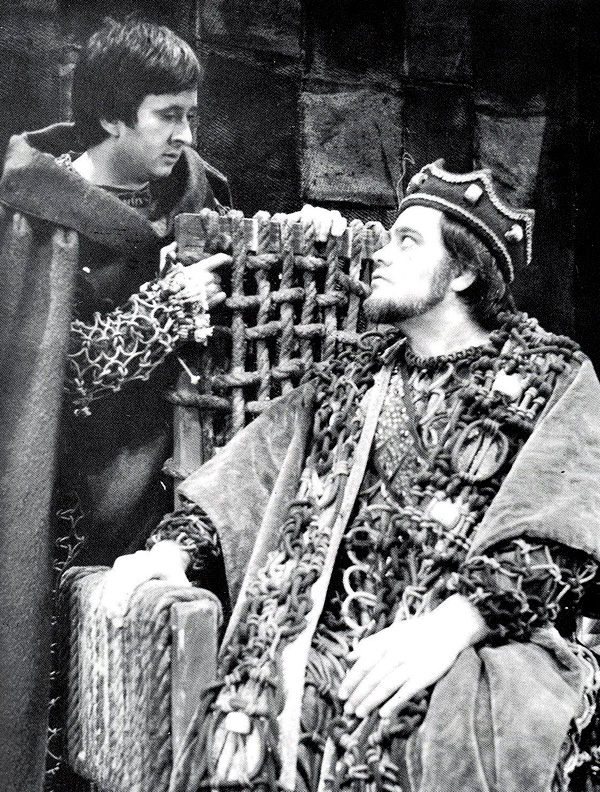
Shakespeare: The Life and Death of King John
N.K. Ivan Zajc Rijeka, 1978./1979.
Awarded costumes by Ružice Nenadović Sokolić.
On the photo: Nenad Šegvić i Zdenko Botić.
Ružica Nenadović-Sokolić graduated from the Academy of Applied Arts in Belgrade in 1952.
She spent her whole active life, more than forty years, working in the Croatian National Theatre Ivan Zajc. Her career started with a remarkable creation for the opera Il Trovatore (1954), after which she continued very successful cooperation with other opera and drama productions. She also designed theatre posters.
Positive reviews of her work led to collaboration with other theatres and festivals in the country and abroad. She worked in Opatija, Pula, Ljubljana, Maribor, Zagreb, Osijek, Split, Sarajevo, Belgrade, Italy, Poland, Czechoslovakia, and in other places. First exhibition-style presentation of her costumes was organised in 1960 at "Mali salon", where she exhibited together with her husband, the scenographer Dorian Sokolić.
She created over 400 costume designs (several thousand individual costumes) which were awarded a number of prizes and recognitions (among which the Award of the City of Rijeka in 1965 for the opera Prince Igor, Republic Award Vladimir Nazor in 1979 and the Golden Medallion at the 6th International Triennial of the Theatrical Scenography and Costimography in Novi Sad in 1981 for the performance The Life and Death of King John)
The aim of the exhibition of her sketches, collages and costumes during the International Small Scenes Festival in Rijeka is to remind about her exceptional contribution to costimography and her talent, which, as theatre reviews often remarked, could be compared to that of the greatest costume designers in the renowned opera houses around the world.
In the atrium and on the first floor of the Croatian House of Culture we can see her work sketches and collages form the drama performances Thursty Source (1968/69), Life and Death of King John (1978/79) and Hasanaginica (1982/83), as well as from the operas Ernani (1971/72), Aida (1985/86), Nabucco (1987/88), Carmen (1988/89), Norma (1989/90) and Lizinka (1989/90).
Depending on genre and theme, the author's handwriting changed, nevertheless preserving its recognisable signature. Ružica Sokolić's multi-layered costumes with stylized details, creased fabrics, and matching colours with a multitude of golden, copper and red nuances accentuated characters on the scene. Facial expressions, body postures and colourful costumes in her drawings reveal the complexity of the characters and their true nature.
The exhibition of Ružica Sokolić's work testifies of the outstanding quality of her creativity and her ability to transmit and elaborate the director's conception of the characters and to enliven the scenography, creating an exquisite ambiance.
From Scene and costumes by Ervin Dubrović, Muzej grada Rijeke, Rijeka, 1998