
Hrvatski kulturni dom na Sušaku - 9. 5. (Saturday) at 18.00 & 21.00 h
Volksbuehne Berlin, Germany
Brecht: HE WHO SAYS YES, HE WHO SAYS NO
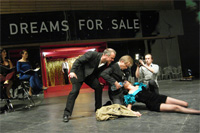
Frank Castorf, middle generation German director and director of Volksbühne am Rosa-Luxemburg-Platz is one of the most prominent names of the European theatre. Imbibed with strong energy which is the result of the confrontation of violence and harmony on the scene, his plays avoid linear narration and simplistic conclusions.
In the nineties a rebel in the East, communist Germany, after the fall of the Berlin wall he became the critique of the new era based on cruel capitalist rules of profit. Since both political systems ignore the little folk, Castorf in his performances fights against social manipulation, while the false happiness of capitalism becomes an ideal frame for new critique.
Shakespeare, Hauptmann, Dostoevsky and Tennessee Williams are in his productions exposed to radical interventions, and Brecht, as a big critique of the capitalism imposes itself as a logical choice. Following his Der Jasager, a school opera written at the end of the twenties which had spurred stormy polemics, Brecht wrote Der Neinsager. Most modern interpretations link these two plays into one single production. In the centre of the writer's attention in both plays is a young man who goes on pilgrimage to pray for his mother's health. He gets sick, after which, in accordance to an old tradition, he is doomed to death and thrown over the mountain.
Using Weill's music, Castorf linked two plays in a potent cabaret. The deconstruction, which as a renowned representative of the post-drama theatre he often uses, in combination with intensive use of music and effects of surprise, resulted with a critical and extremely dynamic production that can rarely be seen on stage.