


Croatian House of Culture – 5. 5. u 6.00 p.m. & 8.00 p.m.
Atelier 212, Belgrade – Serbia
Maja Pelević: ORANGE PEEL
Directed by: Goran Marković, set design: Nebojša Veselinović, costume design: Boris Cakširan, music and songs: Katarina Žutić, music producer: Petar Rudić, scenic movement: Dalia Aćin
Cast: Jelena Ilić (Orange), Katarina Žutić, Jelena Jovičić, Srđan Timarov
First night: 30. 4. 2006. Duration: 75 min.
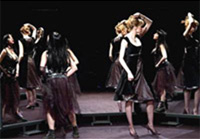
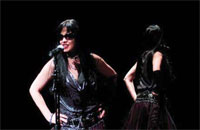
Writer and theoretician, Maja Pelević (Belgrade, 1981) is one of the most talented Serbian playwrights of the younger generation, and Orange Peel (the title is a euphemistic term for cellulitis) it is her sixth performed drama. It was put on the stage of the legendary Belgrade theater, Atelier 212, by well-known film director Goran Marković who transformed it, in the words of critic Goran Cvetković, into a "tender faultfinding cabaret" from which "amazing sparks of poetry that emanate the consciousness of lost generation". Orange Peel is about a reexamination of the feminine identity in a society that in various ways, especially through the media, strives to form the demeanor and looks of the modern woman. On the one hand, the drama follows the story that refers to media pressure, while on the other – it follows the intimate confession of a woman who is attempting to fit into the role that is expected of her and fails to do so. Maja Pelević got the idea for this drama quite spontaneously, instigated by the advertisement for NIVEA body cellulite cream and magazines for women that are capturing the market.
By assertion of an original emotionality and unfettered sensuality, Orange Peel conveys the rebellious credo of the (post) modern emancipated woman. On a genre level, the authoress utilizes the susceptibility of the melodrama, the attraction of the tragicomedy permeated with "nonsense" humor, and the deadly theoretical criticality of late feminism – in order to go beyond all these factors and weaves in a nightmarish and erotic provocativeness of a kind of discursive ballad. Formally and stylistically this play depicts a disjointed, but nevertheless complete, dramatic network within which the identities of the characters are scanned, consolidated and transformed, while the plot "hovers" between fragments of dialogue and antiillusionistic monologue, by way of making a parody of the forms of fashion recipes, ads and classical literary "stream of consciousness", to a destructively aloof partsinging... and commentator passagios of the repeatedly dissevered and problematized author's Voice... The formal disjointedness of the play wants... to show precisely the futility, limitation and uselessness of living in the shackles of formal gestures and hollow rituals. The thematic and formal gradation with which Maja Pelević guides the reader/ spectator to a cognition of this problem is indeed admirable... We are talking about a mixture of horror and irresistible comedy... inhibited emotionality in which under a cloak of order vanity reigns. In such a world, the dilemma that confronts the Heroine – and the Authoress – is: to be a perfect cyborg, or a discarded wreck, a detestable torso of suppressed desires. But both one and the other (awareness and instinct), transcending the horizon of the conjured conflict, choose "the orange peel" – the aura of imperfection that will, on every new morning, enable them at least a moment of awful, but of such precious freedom.
From the text of Svetislav Jovanov
in the anthology of "most recent Serbian drama" Predeath Youth