


Dinko Lukarić Hall; Kozala – 8. 5. 9.00 p.m.
Emilia Romagna Teatro Fondazione, Modena - Italy
Pippo Delbono: THIS WILD DARKNESS
Conceived and directed by: Pippo Delbono, set design: Claude Santerre, light design: Robert John Resteghini, technical director: Sergio Taddei, sound: Angelo Colonna, light technician: Fabio Sajiz
Cast: Pippo Delbono, Dolly Albertin, Gianluca Ballar, Raffaella Banchelli, Bobo, Margherita Clemente, Lucia Della Ferrera, Ilaria Distante, Gustavo Giacosa, Simone Goggiano, Mario Intruglio, Nelson Lariccia, Gianni Parenti, Pepe Robledo
First night: 3. 10. 2006.
Duration: 90 min.
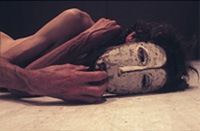
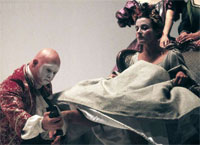
The performances by Italian actor and director Pippo Delbono(Varazze, 1959), in which drama critics discern diverse and seemingly hard-to-connect influences (for example, Dante and Pasolini, Artaud and Fellini), incessantly make rounds of theaters and festivals throughout the world, and in Italy and France they almost have a cult status. Developing his theatrical style on the principles of anthropological experiences of the Barba's theater (by means of Iben Nagel Rasmussen) and the expressionist dance of Pina Bausch, Delbono as a director moved into the foreground for the first time in 1987 when he created the theater play Il tempo degli assasini together with his permanent coworker, the Argentine actor Pepe Robledo. This was followed by a series of projects with actors and dancers of various schools, but the moment of greatest importance in Delbono's career took place in 1997 when he presented the performance of Barboni in which, with the engagement of homeless persons, street entertainers and handicapped persons, he explored the boundary lines between life and art. From that moment, the collision of life's reality and the theatrical illusion became the essential postulate of the Delbono theater. The group of artists that had hitherto performed as his team is joined by the Barboni ensemble to form a series of exciting performances (Guerra, Il Silenzio, Gente di plastica, Urlo), which highlight Delbono into one of the most original author personalities of the contemporary European theater.
The fundamental framework of Delbono's most recent performance, Questo buio feroce (This Wild Darkness), is based on the book by American writer Harold Brodkey (1930-1996), in which the author describes his struggle against AIDS. Delbono came upon the Italian translation of Brodkey's book, he says, by pure coincidence, "on the shelf of a small bookshop, in a country without books", and in it he found "his own journey, his own history", but also a kind of resistance towards the West's apprehension of death linked to feelings of fear, pain and loss. In his search for a light at the end of the tunnel, Delbono is also inspired by the works of other artists – e.g., the poetry of Emily Dickinson, the paintings of Caravaggio, Botero and Frieda Kahlo, Pasolini's film Salň, creating a powerful scenic work that critics described as a "funerary ballad" and "masquerading of a disease", which even prompted "old ladies, in love with Goldoni and Pirandello, Shakespeare and Moličre, to applaud with a sports fan passion and elation of girls attending rock concerts".
One of the rare authors of the contemporary theater capable of expressing strong emotions... is Pippo Delbono, and his latest presentation, This Wild Darkness is no exception: it is a genuine and unfeigned punch in the stomach, and the final impression brings to mind the moment, after the pain has subsided, when you catch your breath, regain the rhythm of breathing and feel alive again... The thing that Delbono fearlessly brings to the stage is the human pain that he throws into the face of the benevolent audience, with a great deal of concealed feelings of guilt, as a cause-and-effectt link between their well-being and the poverty of all others. »Millions of people are dying so that you can be free and happy«, his voice keeps on repeating. All this, of course, has a shattering effect, but more than anything else, as usual, our excitement is aroused by Delbono's remarkable "actors and non-actors" picked up on the road (among whom one has Downs Syndrome, then there's a paralytic, a tramp, a deaf-mute); an incredible and diverse group of characters whose faces bear the marks of suffering and hard life, with virtually naked bodies, yet full of an incentive energy through which they establish contact with the audience.
Marcello Garbato,
Giudizio Universale