


Croatian House of Culture Sušak - 3. May 7.30 p.m.
Ulysses Theatre, Brijuni, Croatia
Ivo Štivičić - Miroslav Krleža: DRUNKEN NIGHT IN 1918.
Directed by: Lenka Udovički , dramaturge: Tena Štivičić , set design: Zlatko Kauzlarič-Atač , costume design: Bjanka Adžić-Ursulov , music: Nigel Osborne , choreography: Natalija Manojlović , light design: Zoran Grabarac , sound design: Davor Rocco , assistant director: Marin Lukanović
Cast: Sreten Mokrović (Miroslav Krleža) , Sven Medvešek (lieutenant colonel Kvaternik, citizen) , Ksenija Marinković (Zovka, citizen) , Nina Violić (Zlata, citizen), Linda Begonja (Olga, citizen) , Branislav Lečić (lieutenant colonel Simović) , Nebojša Glogovac (colonel Vesović) , Krunoslav Klabučar (captain Križanić, mayor Skrulj , citizen) , Damir Šaban (sergeant Pintarić, doctor Mate Drinković, citizen) , Zoran Gogić (Svetozar Pribićević, citizen) , Mladen Vasary (maitre d' Mlinarić, citizen) , Lucija Šerbedžija (Fanika, citizen) , Ivan Đuričić (soldier Blaž, waiter, citizen, captain Terzić) , Damir Borojević (Icek, citizen, soldier) , Sven Jakir (corporal Petrak, waiter, citizen, soldier Bartol, Serbian officer) , Damir Poljičak (soldier Šime, waiter, citizen, captain Ratković, Serbian officer) , Josipa Lisac
Musicians: Ranko Purić , Mostar Sinfonietta (Aidan Burke, Anton Pešikan, Belma Alić, Clea Friend) , Zlatni dečaci (Aleksandar Asanović, Igor Usinović, Burhan Huseini)
First night: 10. 8. 2007.
Duration: 130 min.
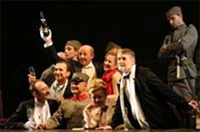
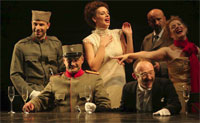
The Ulysses Theatre was founded in 2001 by actor Rade Šerbedžija and writer Borislav Vujčić, envisaged as "a theatrical sphere of permeation among spiritually related artists". The premiere performances of all nine plays by this theater were held on the Brioni archipelago, where Ulysses organizes various cultural events during the months of July and August. The first public performance of Drunken Night 1918 was the central event of the 2007 Brioni Summer, which was entirely dedicated to the bard of Croatian literature, Miroslav Krleža. The text of the performance was written by the prestigious Croat screenplay writer, Ivo Štivičić. He conceived his first work for the theater as a sort of "symphony" in which fragments from Krleža's various works are squeezed into the mainstay novella A Drunken November Night In 1918 that depicts the dramatic occurrences at the end of 1918 when for the first time in the history of the Croatian people a conceptual conflict occurred over the issue of an unconditional South Slavic unification or an independent Croatian state, which in practice signified a conflict between idealism and reason, illusion and reality. Drunken Night 1918 won the Audience's First Prize at the 41st Belgrade International Theater Festival (BITEF).
In the Brioni night... the young and rebellious Miroslav Krleža of 1918 is introduced as an authentic hero of our times, and Ulysses' household director, Lenka Udovički creates her best directing so far, while the political reality - something like history on the move - whizzes past us like a black humor cabaret of all the tragic Yugoslavian misunderstandings. Six embarrassing minutes are extracted from this factual history: those in which the young Miroslav Krleža in the chamber of the Zagreber Kolo in November 1918, right after the end of the First World War, publicly protested because general Eugen Kvaternik had exchanged kisses with Serbian officers with whom, only yesterday, as an Austro-Hungarian officer, Serbs were the targets that he sighted with his rifle. That night, in which our domestic rebel accused Croatia's elite that they "want to eat from the Serbian kettle just like they ate from the Austrian and Hungarian" was nevertheless, no matter how one looks at it, important for us today because those were the days when the "strategy of geese in a fog" assembled the unification of a state of Serbs, Croats and Slovenes that will seventy years later bring about a gory breakup just because it was executed in a morally ungainly manner... Lenka Udovički... in those six minutes that shook Zagreb, expands them into a social and political context of the Croatian situation of that time... and the result that we get - without any specific lecturing or pathos - is a cabaret-like experience of history in which, in a grotesque manner, we recognize the main heroes and how they behave... Such a reductionist procedure clears the area to enable a belated view of the basic dramatic conflict that moves from life onto the stage; Krleža at that time didn't stand a ghost of a chance against the perfidious political establishment and feverish masses..., and after him, there were all those others who, pertaining to the rule of "one against all", always took a beating in their struggles with the fuzzy mentality of these regions...
Bojan Munjin,
Kazalište