


Croatian House of Culture – 7. 5. 7.30 p.m.
Slovenian National Theatre DRAMA, Ljubljana - Slovenia
Ivo Svetina: OEDIPUS IN CORINTH
Režija/Directed by: Ivica Buljan, dramaturgija/dramaturge: Diana Kolonini, scenografija/set design: Ivan Kožarić, kostimografija/costume design: Ana Savić Gecan, glazba/music: Mitja Vrhovnik Smrekar, koreografija/choreography: Tanja Zgonc, asistent režije/assistant director: Robert Waltl
Igraju/Cast: Marko Mandić (Polib/Polybus), Veronika Drolc (Meropa/Merope), Saša Tabaković (Edip/Oedipus), Uroš Fürst (Agron), Petra Govc (Tihe/Tyche), Aljaž Jovanović (Leuk/Leukos), Jose (Veliki svećenik/The High Priest), Polona Vetrih (Pitija/Pythia), Alojz Svete (Izbjeglica iz Tebe/A refugee from Thebes), Katja Levstik, Barbara Levstik i/and Ditka Haberl (Zbor/Chorus), Anže Palka (Gitarist/Guitarist)
Premijera/First night: 7. 10. 2006.
Trajanje/Duration: 115 min.
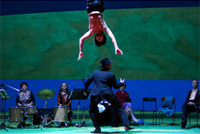
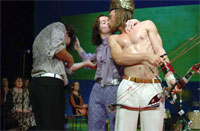
Slovene writer, Ivo Svetina (1948), says that he began imagining his drama about Oedipus near the end of the 1960's, when in a movie theatre in Rome he saw Pasolini's film King Oedipus, in which Oedipus "is not a forgotten and tragic hero locked in a myth", but someone "living in a world, a utopia, of dreams and hopes" of those "heroic Sixties". Inspired by Pasolini's film, Svetina inscribed his Oedipus at a time when it still seemed as if the tragic fate could be averted. His drama is about Oedipus before Oedipus, prior to those ominous events when, not knowing what he was doing, he kills his father and marries his own mother. Some twenty years after the emergence of his drama, Svetina's Oedipus in Corinth, was for the first time staged by Ivica Buljan, Croatian director who evenly created his opus in Croatia and in Slovenia. On occasion of the last Borštnik's Gathering, the central Slovenian Theater Festival, his presentation won four awards: for the performance as a whole, as well as for directing, acting (M. Mandić) and for best young actor (A. Jovanović).
The theater is an art of filth, its purpose being to defile the world, make it even dirtier, more unrecognizable than it is. It is not possible to do this on television or in the movies. The theater is art, precisely because it portrays the world's system through disorder. Svetina's Oedipus takes us to the core of that disorder. And not only on the storytelling level, even though it is a very interesting plane, but I was more intrigued by the motif of questioning our own being in the world. These are the simplest questions that are always the most challenging: who am I, where do I come from and where am I going? And here they are called for by a hero, who is not yet a tragic one and is therefore, sure enough, good-looking ... an adolescent, lustful beauty without reflection ...
Ivica Buljan
interview published in the program booklet for the show
Director Ivica Buljan approaches Svetina's poetical drama, written in a refined and elaborate versification, without awe, in a paramount and deliberate manner, to some extent condensing a complicated story, parts of which, especially the chorus parts, he transforms into songs. What remains of the hero's tragic attempt to ward off his doomed fate turns into a Balkanized carnival, introduced and conceived already in the introductory scene of a sacrifice ritual, and thereafter like a red thread squeezing throughout the entire play. The dislodgement outside of history to the Balkans, with its wild and uncontrolled passions, is successfully supported by the forceful and sinister music of Mitja Vrhovnik Smrekar, executed live; and the cunning and partially burlesque intonated choreography of Tanya Zgonc, as well as the costume designs of Ana Savić Gecan which look as if they came out of the motion picture of Kusturica. The presentation insists on a Dionysian, forceful, wild, and above all a radical, omnipresent eroticism…
Matej Bogataj,
Radio Slovenia
The crucial relevance of this presentation is that it lives as a sum of diverse artistic inspirations and creative energies… during which it utilizes, in an equivalent measure, specifically theatrical approaches and procedures as well as instigations from other fields of artistic performance and creativity – to merely mention the spacial in(ter)vention of Croatian artist Ivan Kožarić and the "chorus" of Katja and Barbara Levstik and Ditka HaberI... The result is a lively, brave, fresh performance that we certainly need more of.
Petra Pogorevc,
Dnevnik