


Croatian House of Culture – 10. 5. 7.30 p.m.
Gavella Drama Theatre, Zagreb - Croatia
William Shakespeare: MIDSUMMER NIGHT'S DREAM
Directed by: Aleksandar Popovski, translated by: Milan Bogdanović, translation edited by: Josip Torbarina, dramaturge: Dubravko Mihanović, set design: NUMEN, costume design: Jelena Proković, music: Kiril Džajkovski, choreography: Daša Rashid, light design: Zdravko Stolnik, acrobatics: Christian Rene Peter i/and Iva Peter Dragan (Udruga Triko/ The Triko Association)
Cast: Hrvoje Klobučar (Theseus), Ksenija Pajić (Hippolyta), Janko Rakoš (Egeus), Franjo Dijak (Lysander), Sven Šestak (Demetrius), Bojana Gregorić Vejzović (Hermia), Nataša Janjić (Helena), Nenad Cvetko (Quince), Ozren Grabarić (Bottom), Janko Rakoš (Flute), Đorče Kukuljica (Snout), Filip Šovagović (Starveling), Ivan Đuričić (Snug), Hrvoje Klobučar (Oberon), Ksenija Pajić (Titania), Pero Kvrgić (Puck), Christian Rene Peter, Iva Dragan Peter and Jadranka Žinić Mijatović (the mischievous elf-fairy and other fairies)
First night: 21. 12. 2007.
Duration: 100 min.
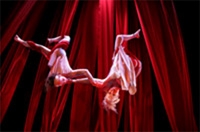
Macedonian stage and film director, Aleksandar Popovski (Skoplje, 1969), described his production of A Midsummer Night's Dream in the Gavella Drama Theater as "a struggle for an illusion". The key stage set element of his performance is the stage curtain into which, as if into a web of dreams, the characters from both dimensions of Shakespeare's play get entangled. Their bellwether is the elf, Puck, who according to Popovski "prompts and pushes occurrences", because "he knows the secret -- he knows the importance of dreaming, and to what extent". But in this performance Puck even exceeds the dimensions of the play itself; namely, he is endowed and ncrypted with specks of the miraculous actor biography of the man who lends him his corporeal form, the 81-years old legend of the Croatian theater, Pero Kvrgić. "Kvrgić's Puck is at the same ime clear as a forest spring and exhausted from mischief-making s a multi-centenarian; he has a child-like nimbleness and an old age infirmity; he is melancholic and rampantly playful", says Nataša Govedić, reviewer of newspaper ovi List. Other reviewers describe Aleksandar Popovski's presentation as "fanciful, funny and obscene", like a "pop approach" to Shakespeare, "sprinkled with a touch of Brecht-like magic dust as a hint that the theater is something more than just a detached play".
Questions of the meaning of love, dreams, illusions, ideologies today... interest all of us, and the Dream is precisely made up of these elements. It is in a certain sense even radical, because we have abandoned "dreaming", it has become "out". Today dreams are hard to find on the market. The world of fancy, myths, of the subconscious... – for me the world of beauty – is covered with a curtain behind which we rarely throw a glance... In this performance we did not want a complete separation of reality and dreams – it is altogether, perhaps, the dream of an old man, perhaps Puck's, and possibly of the actor, Pero Kvrgić. I see the orm of this play like a ball. In it is another ball, and then another... A dream in a dream in a dream... Up to Puck's final monologue hat we "borrowed" from Prospero, because Pero Kvrgić is undoubtedly Prospero as well, just like A Midsummer Night's Dream and The Tempest are in places the same text...
Aleksandar Popovski
interview published in the program booklet of the performance
Even though the rhythm is apparently muffled, the performance is charged for a polyphonic explosion of playful acting; through facial expressions, in pauses between rebuttals, through the music, through the setting, in the spleen that embraces the entire stage and spills over into the audience... The peak of awakening is Bottom's descent into the auditorium where he demands to be told whether all that happened was a dream. Of course, he gets no answer, because a dream has a thousand answers and we never really know if we are awake. The performance ends with all the cast continuing their lives prior to the dream, but their faces bear expressions of incredulity. They are uncertain if they are carrying on with their same life, or perhaps the dream changed it. With that curiosity they move into another world, a labyrinth of curtains which from banners transform, at once into a forest, then into a void, then into a darkness from which some new dream could appear once again. At the end of the performance Puck disrobes and once more lies down into the same position as when he awakes at the beginning of the performance. All this was his dream. Was it only his?
Andrija Tunjić,
Vjesnik