


Croatian House of Culture - 4. 5. 6.00 p.m.
Belgrade Drama Theatre, Belgrade - Serbia
MESS, Sarajevo - Bosnia and Herzegovina
Mirza Fehimović: GUSTO
Director, adapter and set designer: Egon Savin , costume design: Snežana Pešić Rajić , sound design: Zoran Jerković
Cast: Ljubomir Bandović (Salko Halilović) , Dubravka Stojanović (Esma Halilović) , Radmila Tomović (Munevera Petrović) , Nebojša Ljubišić (Stevan Petrović) , Sandra Bugarski (Klara Horvat) , Slobodan Custić (Hamo Mutevelić) , Lako Nikolić (Mirko Petrović) , Ana Sakić (Mejra Halilović) , Jovana Cvetković (Elizabet Petrović)
Premijera/First night: 31. 10. 2007. Trajanje/Duration: 90 min.
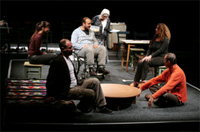
Two years ago the Sarajevo MESS Festival and Belgrade Drama Theater announced an open competition for a contemporary dramatic text in the Bosnian and Serbian language that "affirms the principle of an open-minded spirit and is engaged in the need for a critical reappraisal and change of our reality". The award in this competition went to writer from Bosnia-Herzegovina, Mirza Fehimović (Sarajevo, 1955) for his drama Gusto, a naturalistic grotesque on postwar Sarajevo and the reunion of Sarajevans who stayed in the city and of those who moved out. Nostalgia and a questioning of the reasons for a common calamity, fear of being misunderstood, mutual remonstrations, feelings of guilt, but also the awareness of possibility to forgive; all this is intertwined in the drama through small neighborhood and family accounts; a story of the entangled destinies of several persons bearing dissimilar encumbrances, but with equally painful wartime and postwar experiences. The first public performance of Gusto, shown on occasion of the 47th MESS, was directed by Egon Savin. This director has twice already been guest of the International Small Scenes Theatre Festival - in 2005 (Have I None by E. Bond) and 2007 (Extinction by D. Spasojević).
Gusto by Mirza Fehimović is a drama of fragmentary structure, and its plot evolves in Sarajevo in 2001; the main characters are members of two families, one which returns from exile in England. Their reunion produces a chain of conflicts and opens important issues: confrontation with the past, recollections of violence and wartime devastation, feeling of guilt, demystifying of fabricated myths in reference to patriotism and heroism... The author depicts them lucidly, sometimes poetically, with a dose of mild humor that somewhat mellows the omnipresent tragic element. The play directed by Egon Savin is austere, sharply exact, unpretentious, deliberate... The cast, with limited means, subtly and very expressively underline the deep tragedy and suffering of the victims of merciless political conflicts in which all the people are losers, regardless of whether they left or stayed... A characteristic of the performance is an expressive, pregnant, disturbing silence that is sometimes disrupted by the ghostlike rumble of street noise, stressing how unbearable it is to put up with the ostensible calm. In the depths, of the mainly barren playing area there is a row of empty chairs that incessantly... bespeaks of a dreadful absence of many persons... This refinement of expression, absence of predictability and absence of a desire to illustrate, on top of accentuation of the metaphoric and associative through theatrical ymbols, are distinctions... that make the performance artistically worthy, in its picturesque analysis f our post-traumatic reality in which all are helplessly buried in a kind of interspace and intermission... in which there is o life, but just a kind of reflection of life. But also a desperate and admirable striving to survive, nevertheless.
Ana Tasić,
Politika