


Croatian House of Culture Sušak – 1 May 6.00 p.m. and 8.30 p.m.
Belgrade International Theatre Festival – BITEF and the Yugoslav Drama Theatre, Belgrade - Serbia
CIRCUS HISTORY
Idea, direction, set design, costumes and music selection: Sonja Vukicevic
Cast: Branislav Lecic (Macbeth), Dragan Micanovic (King Lear), Anita Mancic (Hamlet), Tamara Vuckovic (Othello), Miloš Vlalukin (Jan Kott), Mira Ðurdevic (Titus Andronicus), Hristina Popovic Mijin (Richard III), Marko Ilic (Clown), Ana Stamenkovic, Marija Grbic, Tijana Krsmanovic (Ballet dancers)
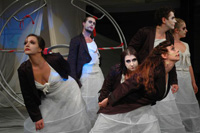
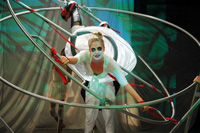
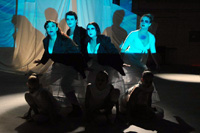
Sonja Vukicevic is not only known as a member of the Belgrade National Theatre Ballet Ensemble, but throughout former Yugoslavia also as a famous choreographer of numerous shows directed by renowned national and foreign directors (Pašovic, Viktjuk, Jovanovic, Popovski, Stojanovic and others). Sonja started her independent directing and choreographic career in the mid-nineteen-nineties in the Belgrade Centre for Cultural Decontamination (Macbeth/ONO, Alzheimer, The Process, Midsummer Night’s Darkness), while her latest show, Circus History, is the first independent production in the forty year long history of BITEF. Based on fragments from Shakespeare’s tragedies and on Jan Kott’s comments, Circus History effectively combines clownery, acrobatics, jugglery, and superior acting in order to expose the anatomy of violence and the history of evil, interpreting them as formative elements of the Grand Mechanism of History.
In his anthological … analysis of William Shakespeare’s history chronicles, Jan Kott distinguishes the functioning of a ruthless and absolute principle, one that he has named the Grand Mechanism of History. Such a principle implies that … the flow of history amounts to a single vicious, infernal circle in which every attainment of power begins as a fair and honest struggle against tyranny and inevitably ends in the establishment of a new tyranny. ... Seen in such a manner, Shakespeare’s understanding of history becomes completely pessimistic, because it rejects every possible transcendence and teleology of historical flow, and is presented as an utterly senseless and closed string of violence. It seems that today, even more than some forty years ago, when Kott formulated his ideas, such an understanding of history is reflected in our world, a world depleted of utopias, ideals, and ecumenical concerns. It is precisely such an understanding of the world and of history that Sonja Vukicevic deals with, transforming it through her artistic imagination into a powerful metaphorical concept – that of the circus. Kott’s absurd motion within the circle of crime, in Sonja Vukcevic’s vision becomes a grotesque circus arena in which the human body and soul are cruelly and mercilessly – yet seemingly merrily, exposed, degraded, and tortured. Besides being absolutely desacralized and its grotesque nature exposed, such a reduction of history to a circus bears another important message: it points to the contemporary craze for media (ab)use of political and historical events, to a voyeuristic hedonism, with popcorn and ice-cream in hand, over historical cataclysms which, thanks to television broadcasts, occur before our placid gaze.
Ivan Medenica
While the actors continuously shower the audience with arrows of lucid ideas compiled from Shakespeare’s works, Circus History functions simultaneously as a letter of horrible intent and as bloody history in its purest of forms. The show hovers on the thin edge between the humane and the absolutely savage: the human race is revoked, and with it its traits – ethics, aesthetics, and morals, for the sake of showing that what counted a hundred years ago, is of no value today, and that a selfish world like ours can no longer move ahead.
Bojan Munjin, Feral Tribune