


Croatian House of Culture Sušak – 30 April 7.30 p.m.
Sud Costa Occidentale, Palermo – Italy
(in cooperation with Romaeuropa Festival 2004)
VITA MIA
Directed by: Emma Dante
Dramaturgy: Emma Dante
Light design: Christian Zucaro
Cast: Ersilia Lombardo, Enzo Di Michele, Giacomo Guarneri, Alessio Piazza
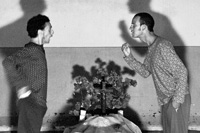
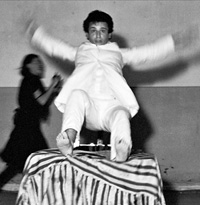

Emma Dante is one of the most original and respected creators of contemporary Italian theatre. She was born in 1967 and graduated in 1991 at the Academy of Dramatic Arts "Silvio D'Amico" in Rome. She started her career as a theatre, film, and television actress. In 1999 Emma returns to Palermo and founds the Sud Costa Occidentale Group which aims at offering a critical view of life in the closed environment of Palermo. By exploring and exploiting personal experience, body language and their intellectual habitus in shows produced in Sicilian, which are stripped of most external effects, the actors are compelled to turn to the essence of theatrical creativity. Basing its repertoire on the creation of archetypal images through the presentation of eternal themes, the exploratory theatre of Sud Costa Occidentale still strongly emanates a genius loci by transforming the Sicilian environment, with all its traditionalistic clichés and restrictions, into a universally recognizable symbol. That is the framework within which Vita Mia is created; a small theatre jewel of ritual inspirations and bitter poetic tones. Premiered in 2004 at the Romaeuropa Festival, Vita Mia is another in the line of Emma Dante’s the Sud Costa Occidentale Group’s successes, among which by all means stand out two other "endemic shows" (forming some kind of trilogy with Vita Mia), that of mPalermo (2001) and Carnezzeria (2002), both awarded the UBU prize.
We enter an empty room in the centre of which lies a large bed. We ask ourselves whether that bed signifies a shelter, peace, or the passage of time? It is around such a deathbed that a journey through space and time commences, a journey propelled by obscure and incomprehensible forces. The room we enter is a hole set in "nowhere"; the place in which the soul soars before it separates from its body. With sadness in her eyes, a mother is looking at her three sons and telling them that life is the most valuable thing on earth, something that goes by and slips away. Life is a race around that bed.
Vita Mia is an insane and desperate attempt at slowing down in the last round before death. Whose turn is it? Who’s been chosen? The eldest or the youngest? The best or the worst one? And, above all, why is it to happen to the one who is the least ready, who has not stopped yet, whose vital impulses are still intact, who has not abandoned his ideas, his discoveries, his plans, and his weak flows of eruptive energy?
Of the three brothers, Gaspar, Uccio, and Chicco – one of them is dead and has to stretch out on the bed, but the mother does not wish to face such a fact. She stumbles, she sits down, she slants her head to the left and the right and looks at each of her sons: the big one, the middle one, and the small one… How can she accept the death of any of them? How will she gain the courage to drag him to the deathbed after she’s dressed him and whispered loving words into his ears? How will her legs carry her without letting her down? Everything is motionless: gestures, memories, words of comfort, a guilty conscience, the rhythm of the last heartbeat that goes on forever.
Vita Mia is a wake.
The bed is a stone ship and the room is the sea that engulfs us and disappears.
Emma Dante